What's For Dinner?
Make dinner time, family time!
Article – Reinforcing Math Skills Through the Multiple Intelligences
Subscribe to our free weekly newsletter
What's For Dinner?
Make dinner time, family time!
Article – Reinforcing Math Skills Through the Multiple Intelligences
Subscribe to our free weekly newsletter
– Jean Fisher
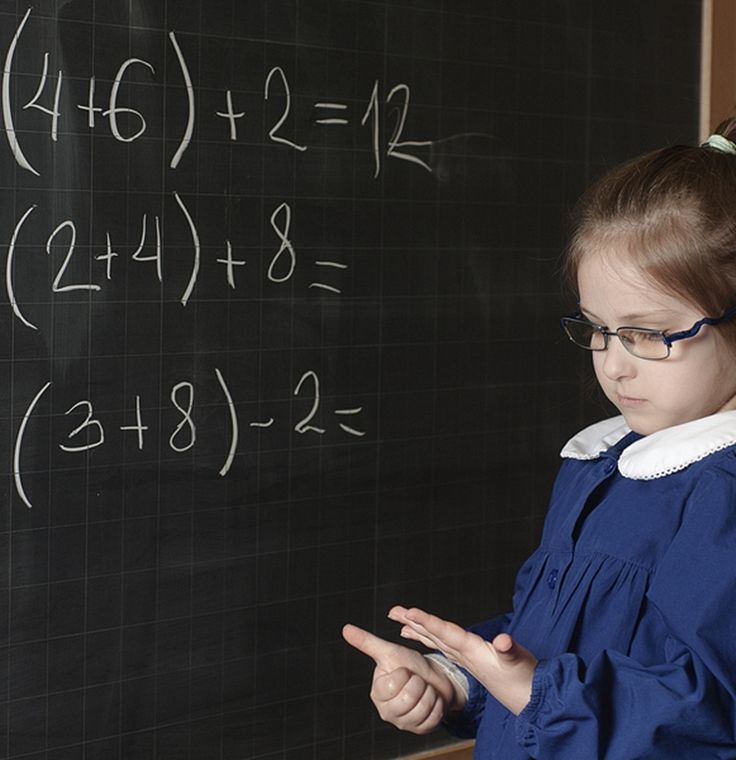
Improve your child's Math skills by tapping into his or her best style of learning.
Share It!
Reinforcing Math Skills Through the Multiple Intelligences

If there is one subject that should be taught on an individual basis, it is mathematics. But most school children do not receive individualized instruction. The majority of math classes consist of a teacher-led lesson directed at the whole class followed by individual practice and sometimes group-activity reinforcement. I have worked in classrooms that allow students to work through a text book at their own pace, using the teacher as a resource when necessary. This works well for students who are strong conceptual learners and can process information through written instructions. But a student who learns better through hands-on experiences will flounder through this type of text-book only learning.
The surest way of guaranteeing that your child encounters mathematical experiences that approach his or her best learning styles is to include math activities in the home as often as possible. But don't start picturing dreary evenings of pencils, erasers and columns of figures. Reinforcing math skills through the multiple intelligences can be lots of fun!
First of all, what are the multiple intelligences?
So now that you have a better understanding of what the multiple
intelligences are, how do you go about putting them to work?
First, find out what your strengths are:
Identify and Understand Your Top Intelligences
Multiple Intelligences Quiz
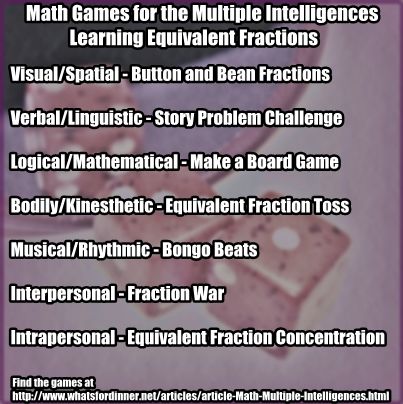
Next, find activities to reinforce skills using the learning styles that indicated the highest tendencies. For this article, we are going to use the skill of understanding equivalent fractions. For each of the seven different intelligences listed above I will suggest activities that use that style of learning as the primary approach.
Visual learners respond well to colors and images. This link takes you to an online lesson that makes excellent use of color and shape to teach fractions.
Awesome Pizza Math Activity A Fun Way to Learn Fractions
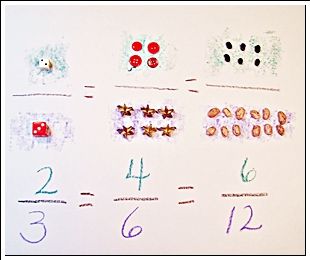
Another great visual learning activity for reinforcing fraction skills you can create using everyday objects in your own home. Choose two common items that you have several of each. For example, two different types of dry beans, two different colors of buttons, pennies and nickels, etc. Now designate one of the groups to represent the numerators of your fractions, the other group represents the denominators. (Parents, use the words numerators and denominators instead of top number and bottom number. Many tests that students must take, expect the student to know the correct math terms.)
Now make groups of the two items to make fractions. For our example, we are going to make the fraction 16/24. So, we have 16 red buttons spread out on the top part of our work table and 24 blue buttons on the bottom.
Next, explain to the child that you are going to make an equivalent fraction that is equal to 16/24 by grouping the buttons of the numerator and denominator. Put both set of buttons into groups of two. Now count the number of groups that you formed and name your new fraction as 8/12.
Okay, repeat the process by grouping the buttons into three's. Oops! There is a problem. Grouping by three's won't work. Even though the blue denominator group divides easily into eight groups of three, you get five groups of three with one button left over in our red numerator group. It is easy to see that this grouping does not name an equivalent fraction. One button left over prevents you from forming equal groups.
Continue trying all the possible number groupings to find the remaining equivalent fractions that can be named from 16/24. Repeat the process with a different numerator and denominator as long as interest remains high.
Verbal learners absorb information easily from written material. A person who is a verbal learner could benefit from well-written instructions and lessons such as the ones provided here by Jamit.com.
Have fun reinforcing equivalent fractions with your verbal learner by creating word problems for each other to solve.
Martha's mother was serving pizza for her birthday party. Including herself, there would be six people at the party. Knowing that smaller pieces of pizza are less messy than large pieces, Martha's mother cuts the pizza into twenty-four pieces. How many pieces of pizza does each person get? What fraction represents each person's share of the pizza? What if Martha's mother had cut the pieces bigger so that everyone got two pieces, what fraction would represent each share?
The greatest challenge you may have reinforcing math skills with the logical/mathematical learner is finding activities that challenge and avoid boredom. Combining the lesson with strategy, the way this online fraction game from the National Council of Teachers of Mathematics does, is great.
For a work-at-home lesson that you and your child can do together, I suggest challenging the mathematical learner to create a game that teaches equivalent fractions. Then prepare yourself to become an assistant in the production. Of course, play the game together when it is complete.
To get the kinesthetic learner motivated, he or she needs
to be touching, moving and manipulating objects. Make your own math manipulatives:
A Math Toolbox
in Every Home
Making and using manipulatives will give your kinesthetic learner a fun challenge.
Make the Equivalent Fraction
Challenge game. You will need:
Place the learner in front of, but a few paces away from, the catching objects. Place the throwing objects next to the learning guide. The guide tosses one throwing object at a time to the learner while calling out the fraction name. The learner catches the throwing object and calls out its fraction name. He or she then calls out an equivalent fraction in the lowest denomination for the throwing object and tosses it into the correct catching object. Play several times. Use a timer and make a graph to measure progress.
Get a musical instrument into that child's hands, what else?
It's a natural, music and fractions go together like brother
and sister. Just start hammering out those quarter notes and
half notes.
Musical Fraction Bars is a fun musical activity for learning fractions.
A challenging musical activity for reinforcing equivalent fractions requires two beating instruments and two beating surfaces. One person beats out the rhythm of the numerators and the other player beats out the denominator. Beat out 1/2 then 2/4, 4/8 and so on. Remember though, that the tempo of 2/4 will need to be twice as fast as 1/2 because all the beats must occupy the same amount of time as the 1/2 beats.
Do you have four players? Have the other two players continue to mark the beats of the fraction expressed in lowest denomination.
Multi-player learning games are great for interpersonal learners.
Make and play fraction games.
Fraction Board Game
Fraction Golf
Interpersonal learners make great teachers because of their tremendous people-skills. Ask your interpersonal learner to teach you equivalent fractions.
Intrapersonal learners love the challenge of skill-drills.
Play a game of equivalent fraction concentration with your intrapersonal learner. Use index cards to create several equivalent fractions. Deal them out face down on the table. Take turns turning over pairs of cards. When an equivalent fraction pair is upturned, the player gets to keep those cards. They player with the most cards at the end of the game, wins.
See, I told you it would be fun! Find a fun learning activity
every day for you and your child at our
Quality Time magazine